What Makes My LinkedIn Content Perform
This data-driven analysis is based on ~70 of my LinkedIn posts over the past year. Scroll to Appendix for the full dataset and performance distribution.
All my posts, compiled in one place, here.
1. The Content Performance Matrix (2x2 Framework)
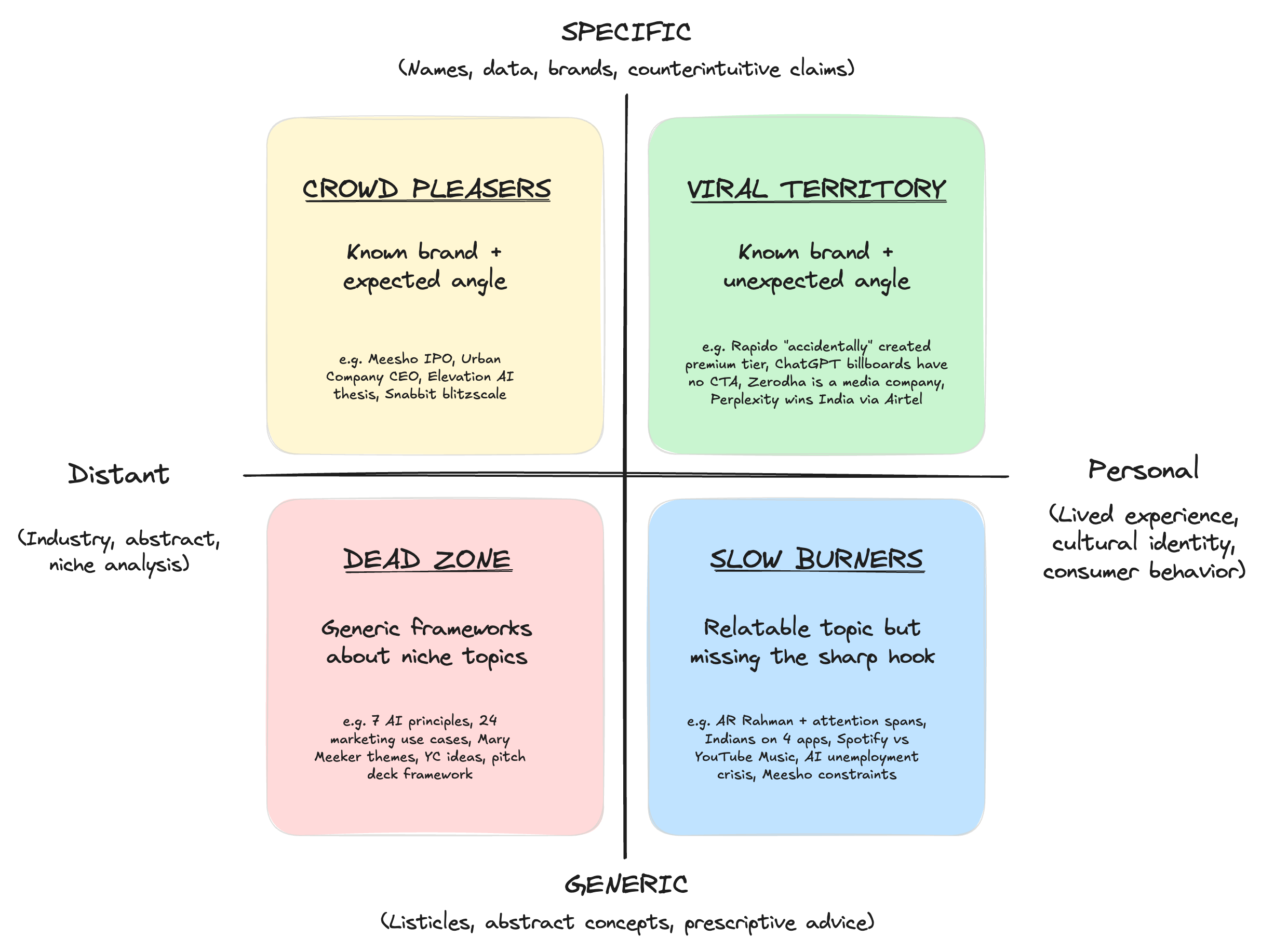
Reading the Matrix
Content performance comes down to two axes:
Specificity – Are you naming brands, citing data, making counterintuitive claims?
Proximity – Can the reader see themselves in your post?
| Quadrant | What It Means | Example | Reader Thinks |
|---|---|---|---|
| Viral Territory (Specific + Personal) | A sharp, counterintuitive insight about something the reader personally experiences. | “Rapido accidentally created a premium tier” – everyone uses ride-hailing, nobody expected this angle. | “Wait, I never thought of it that way” |
| Crowd Pleasers (Specific + Distant) | Solid brand analysis with an expected narrative. Good engagement, not explosive. The reader nods but doesn’t share. | “Urban Company IPO and institution building mindset” – strong analysis, expected take. | “Good analysis, makes sense” |
| Slow Burners (Generic + Personal) | Relatable topic, but the treatment is too broad. The relatability gets you opens; the generic treatment loses you shares. | “AR Rahman’s music and shrinking attention spans” – everyone relates, but the hook isn’t sharp enough. | “Interesting, but I’ve heard this before” |
| Dead Zone (Generic + Distant) | Abstract frameworks about niche topics. Lowest engagement, every single time. | “7 principles to become AI-native today” or “24 marketing AI use cases” – can’t picture it, can’t relate. | “This doesn’t apply to me” |
2. The Six Viral Triggers
After analyzing 15 viral posts across 71, six distinct patterns emerge:
Trigger 1: “The Wait, What?” Effect
Pattern: A counterintuitive or surprising claim that violates the reader’s mental model.
| Post | The Surprise |
|---|---|
| Rapido accidentally created a premium tier | “Accidentally” + premium in a budget category |
| ChatGPT’s India billboards have no CTA | Biggest tech product, zero call-to-action |
| Zerodha has become a media powerhouse | A brokerage as a media company |
| Uber and Rapido meet in the middle | Premium went down, budget went up |
Why it works: The brain’s prediction engine gets disrupted. When reality contradicts expectation, the reader must resolve the dissonance, and that means reading the entire post.
Opening structure: Bold claim in line 1. No preamble. No context-setting. The surprise IS the opening.
Trigger 2: “The India Mirror”
Pattern: Holding up a data-backed mirror to Indian consumer behavior that the reader participates in but has never articulated.
| Post | The Mirror |
|---|---|
| Every foreign company follows this India pricing strategy | You’ve experienced this pricing, never noticed the pattern |
| The Indian Rishta Standards Calculator | You have these standards, here’s the math |
| Will Perplexity win over India with the Airtel deal? | Your telecom bundle, now with AI |
Why it works: When readers see their own behavior described with precision, they feel “seen.” That emotional response drives shares. People tag friends, partners, and colleagues.
Opening structure: “You know how everyone does X? Here’s what’s actually happening.”
Trigger 3: “The Named Brand Collision”
Pattern: Two or more well-known brands placed in unexpected tension or comparison.
| Post | The Collision |
|---|---|
| Uber and Rapido meet in the middle | Premium vs. budget meeting at the same point |
| Quick commerce apps reach peak UX convergence | Multiple apps becoming identical |
| Insights from Bernstein’s deep dive on quick commerce | Wall Street research + Indian startups |
Why it works: Brand names are pre-loaded with mental associations. Placing two known entities in tension creates instant narrative – the reader already has opinions about both sides.
Opening structure: Brand A did X. Brand B did Y. They just collided.
Trigger 4: “The Personal Stake”
Pattern: Authentic personal milestones or career moments shared without performance.
| Post | The Moment |
|---|---|
| Moving on from Elevation Capital | Career transition, vulnerability |
| A special day as Meesho goes public | Insider celebration of a milestone |
| The Indian Rishta Standards Calculator | “I built this” – personal creation |
Why it works: LinkedIn audiences are starved for authenticity. Personal posts bypass the “content evaluation” filter and hit the “human connection” response directly.
Opening structure: “Some personal news:” or “I built X.”
Trigger 5: “The Insider Data Drop”
Pattern: Exclusive or hard-to-find data/research synthesized into an accessible narrative.
| Post | The Data |
|---|---|
| Elevation thesis: Consumer AI x India | VC investment thesis (insider access) |
| Elevation thesis: AI x Financial Services | VC investment thesis (insider access) |
| Insights from Bernstein’s deep dive | Wall Street research (paywalled source) |
| Podcast summary: Nikhil Kamath x Elon Musk | Celebrity conversation (curated highlights) |
| Podcast summary: Nikhil Kamath x Aravind Srinivas | Celebrity conversation (curated highlights) |
Why it works: You’re doing the reader’s homework. They get the signal without wading through the noise. The implicit message: “I have access and taste. Trust my curation.”
Critical caveat: Curation only goes viral when ONE of these conditions is met:
- Author authority – you were an insider (Elevation theses worked because the author was AT Elevation)
- Celebrity pull – the subject is a household name (Nikhil Kamath, Elon Musk)
When neither condition is met, curation consistently underperforms:
- Mary Meeker’s AI trends → Underperformed
- Y Combinator’s startup ideas → Underperformed
- Kunal Shah’s predictions → Underperformed
Opening structure: “Here’s what [credible source] found:” followed by the most surprising data point first.
Trigger 6: “The Practical Unlock”
Pattern: One specific tool or technique that delivers immediate, tangible value.
| Post | The Unlock |
|---|---|
| Generate stunning slide decks with NotebookLM | Specific tool + specific output |
| Claude Code now controls my browser | Specific capability + personal demo |
| I made a website to help you Know Your Zeros | Interactive tool anyone can use |
Why it works: The reader can use this TODAY. The value exchange is immediate and concrete.
Caveat: Tool demos alone don’t go viral. NotebookLM slide decks went viral because the output was genuinely mind-blowing. NotebookLM mindmaps demo? Underperformed. The tool must deliver a “wow” moment, not just a feature walkthrough.
3. The Seven Underperformance Traps
Trap 1: “The Listicle Without a Narrative”
Examples: “7 principles to become AI-native” (Underperformed), “24 marketing AI use cases” (Underperformed)
Listicles signal “skimmable” content. The reader’s brain categorizes it as reference material, not insight. Unless the list contains genuinely surprising items, it gets saved (maybe) but not engaged with.
Fix: Pick the ONE most counterintuitive item from your list. Lead with that. Make the list the supporting evidence, not the headline.
Trap 2: “The Abstract Concept”
Examples: “Indian omnichannel brands operate as two businesses sharing a logo” (Underperformed), “Who is building the TBPN for India?” (Underperformed)
The insight may be genuinely original. But industry jargon (“omnichannel,” “TBPN”) and abstract metaphors can’t be pictured by the average LinkedIn scroller.
Fix: Name the brand. “Why [Brand X] charges you 30% more on Swiggy than in-store and it’s not because of commission.” Same insight, 10x more clickable.
Trap 3: “The Niche Deep Dive Without a Bridge”
Examples: “Science behind Urban Company’s unique rating scale” (Underperformed)
Without a broader implication that connects to the reader’s life, the audience self-selects down to near zero.
Fix: Start with the universal, end with the specific. “Why every service app’s 5-star rating is broken. Urban Company figured out the fix.”
Trap 4: “The Observation Without a Take”
Examples: “AI product marketing is happening on Reels” (Underperformed), “The business model of content creation is dying” (Underperformed)
Observations describe what’s happening. Takes explain why it matters and what it means. Observations feel like news; takes feel like insight.
Fix: Add the “so what.” “AI companies cracked India’s distribution code and it’s not Google Ads, it’s Instagram Reels.”
Trap 5: “The Prescriptive Tone”
Examples: “Seven principles to become AI-native today” (Underperformed), “Elevation’s framework for making great pitch decks” (Underperformed)
“Here’s what you should do” triggers resistance on LinkedIn. Readers respond better to “here’s what I discovered” (invitation to learn) than “here’s what you must do” (implication of ignorance).
Fix: Reframe from prescription to discovery. Not “7 principles” but “The one thing I changed that made AI actually useful in my workflow.”
Trap 6: “The Unauthorized Curation”
Examples: “Striking themes from Mary Meeker’s AI trends reports” (Underperformed), “Y Combinator’s new startup ideas for 2025” (Under), “Kunal Shah’s post-AI predictions are coming true” (Underperformed), “Common thread in IVAR’s India in one tweet” (Underperformed)
Curating someone else’s content without insider authority or celebrity pull. The reader’s implicit question: “Why should I read YOUR summary instead of the original?”
Compare with successful curation: Elevation theses (author worked there) and Nikhil Kamath podcasts (massive celebrity).
Fix: Either curate from a position of authority (“I was in the room”) or add a substantial original layer (“Here’s what Meeker got wrong about India specifically”).
Trap 7: “The Feature Demo”
Examples: “Demo of NotebookLM’s interactive mindmaps feature” (Underperformed), “Chrome with a brain: Dia feels like the browser we were waiting for” (Underperformed), “I got early access to Perplexity’s new Comet browser” (Average)
Product demos and feature walkthroughs feel like marketing content, not insight. Unless the output genuinely amazes (NotebookLM slide decks), it reads as “look at this cool thing” rather than “here’s something that changes how you work.”
Fix: Lead with the problem it solves, not the feature it ships. “I used to spend 3 hours making slide decks. This AI does it in 90 seconds.” The before/after transformation is the hook, not the product.
4. Writing Style Patterns
What viral posts do differently:
| Element | Viral Posts | Underperforming Posts |
|---|---|---|
| Opening line | 1 sentence. Bold claim. No context. | Multiple sentences of setup before the point |
| First-person | “I noticed”, “This tells you”, “I built” | “These are the principles”, “The real X is Y” |
| Sentence length | Short-long alternation. Rhythm. | Consistently long. Academic. |
| Specificity | Names, numbers, percentages in the first 3 lines | Concepts and frameworks in the first 3 lines |
| Reader position | Reader as participant (“you’ve seen this”) | Reader as student (“here’s what you should know”) |
| Tone | Curious observer sharing a discovery | Expert dispensing knowledge |
| Authority signal | Implicit (I was there, I built this) | Explicit (I’m teaching you) |
The Hook Formula (from viral posts):
Line 1: [Brand/Person] + [Unexpected verb] + [Surprising outcome]
Line 2: [Why this matters to YOU]
Line 3: [The data/evidence that makes this real]
Example (Rapido post):
Line 1: “Rapido accidentally created a premium tier within two-wheelers”
Line 2: “by finally splitting bikes and scooters”
Line 3: “It is one change that also fixes both driver earnings AND consumer choice”
Example (ChatGPT billboard post):
Line 1: “One thing curiously missing from ChatGPT’s first-ever billboard campaign in India: a CTA”
Line 2: “Then I looked at the data and understood why”
Line 3: “ChatGPT’s daily stickiness (DAU/MAU) started flatlining in July”
5. Category Performance Analysis
| Category | Posts | Viral | Well | Avg | Under | Win Rate* |
|---|---|---|---|---|---|---|
| Indian Startups & Business | 27 | 7 | 10 | 7 | 3 | 63% |
| India Market Insights | 20 | 8 | 3 | 7 | 2 | 55% |
| Marketing & Brand Strategy | 16 | 2 | 5 | 4 | 5 | 44% |
| AI Industry & Trends | 21 | 6 | 3 | 8 | 4 | 43% |
| AI Tools & Workflows | 13 | 1 | 4 | 3 | 5 | 38% |
| Product & UX Analysis | 9 | 2 | 1 | 4 | 2 | 33% |
*Win Rate = (Viral + Well) / Total posts in category
Key Findings:
Indian Startups & Business leads at 63%. Naming a specific Indian startup gives you the best odds of strong engagement.
India Market Insights is the sleeper category at 55% – and has the highest viral rate (8 out of 20). Posts about Indian consumer behavior punch above their weight.
AI Tools & Workflows has the worst win rate (38%). Tool demos and tutorials feel like content marketing, not insight. The lone viral post (NotebookLM slide decks) succeeded because the output was genuinely jaw-dropping, not because it was a tutorial.
AI Industry & Trends is polarized – viral when anchored to India (Elevation AI thesis, Perplexity-Airtel) but average or underperforming when purely global (Jensen Huang, Mary Meeker, “where is consumer AI headed”).
Marketing & Brand Strategy has the highest underperformance rate (5 out of 16 = 31%). Generic marketing advice on LinkedIn competes with thousands of “marketing gurus” – the bar for differentiation is extremely high.
The India Multiplier Effect
Any topic + India angle = better performance
| Post Type | Without India Angle | With India Angle |
|---|---|---|
| AI Industry | Average (43% win rate) | Viral when India-specific (Elevation AI x India: Viral, Perplexity-Airtel: Viral) |
| Brand Strategy | Underperforms (44% win rate) | Better when naming Indian brands (ChatGPT India billboards: Viral) |
| Product Analysis | Low (33% win rate) | Better with Indian companies (Rapido: Viral, Quick commerce UX: Viral) |
For an audience of largely Indian professionals, the India lens is not just a preference – it’s a performance multiplier. The same analytical framework applied to a US company vs. an Indian company will yield dramatically different engagement.
6. The Curation Paradox
One of the strongest findings: curation is the most polarized content type. It either goes viral or underperforms – there’s almost no middle ground.
Curation that went VIRAL:
| Post | Why It Worked |
|---|---|
| Elevation thesis: Consumer AI x India | Author WAS at Elevation (insider authority) |
| Elevation thesis: AI x Financial Services | Author WAS at Elevation (insider authority) |
| Podcast: Nikhil Kamath x Elon Musk | Massive celebrity pull (Musk + India’s most famous angel) |
| Podcast: Nikhil Kamath x Aravind Srinivas | Celebrity pull (Kamath + Perplexity CEO in Indian context) |
| Insights from Bernstein’s qcomm deep dive | Paywalled Wall Street research (access scarcity) |
Curation that UNDERPERFORMED:
| Post | Why It Failed |
|---|---|
| Mary Meeker’s AI trends | No insider authority, widely available |
| Y Combinator’s startup ideas | No insider authority, freely accessible |
| Kunal Shah’s predictions | Commentary on someone else’s predictions |
| IVAR’s India in one tweet | Derivative of someone else’s content |
| Elevation’s pitch deck framework | Prescriptive, not narrative |
The Rule:
Curate only when you have a right to. Insider access, personal authority, or genuinely scarce content. If anyone could Google it and summarize it, your curation adds no value.
7. Content Type Performance Ranking
From most to least reliable:
| Rank | Content Type | Success Rate | Example |
|---|---|---|---|
| 1 | Original analysis of named Indian brands | Very High | Rapido premium tier, Zerodha media powerhouse |
| 2 | Personal milestone / career narrative | Very High | Moving on from Elevation, Meesho IPO |
| 3 | India consumer behavior insight with data | High | Rishta Calculator, India pricing strategy |
| 4 | Insider research with original framing | High | Elevation theses, Bernstein deep dive |
| 5 | Interactive tool you built | High | Rishta Calculator, Know Your Zeros |
| 6 | Celebrity podcast curation | Medium-High | Nikhil Kamath conversations |
| 7 | Named brand comparison / collision | Medium-High | Uber vs Rapido, quick commerce convergence |
| 8 | Practical AI tool tutorial | Medium | Claude Code use cases, NotebookLM |
| 9 | Broad trend observation | Medium-Low | AI unemployment, superapps comparison |
| 10 | Non-celebrity podcast curation | Low | IPL by Acquired |
| 11 | Curated frameworks without authority | Low | Mary Meeker, YC ideas, pitch decks |
| 12 | Abstract listicles / prescriptive advice | Lowest | 7 principles, 24 use cases |
8. The Golden Rules
- Name the brand. Every viral post names at least one company the reader knows.
- Lead with the surprise. The counterintuitive insight goes in line 1, not line 10.
- Make the reader the subject. “You’ve experienced this” beats “The industry is doing this.”
- One insight > ten tips. A single sharp observation outperforms any listicle.
- Specificity is virality. Numbers, percentages, brand names, city names – concrete details signal credibility and trigger curiosity.
- Discovery > Prescription. “Here’s what I found” beats “Here’s what you should do.”
- Add the India lens. The same insight about an Indian company outperforms the same insight about a global one.
- Curate only what you own. If you weren’t in the room or don’t have insider access, your curation competes with everyone else’s summary.
9. Appendix
Performance Distribution
| Rating | Count | % |
|---|---|---|
| Viral / Extremely well | 15 | 21% |
| Performed well | 19 | 27% |
| Average | 22 | 31% |
| Underperformed | 15 | 21% |